Sleeping Issues: The 4 Hidden Biological Types (Which One Are You?)
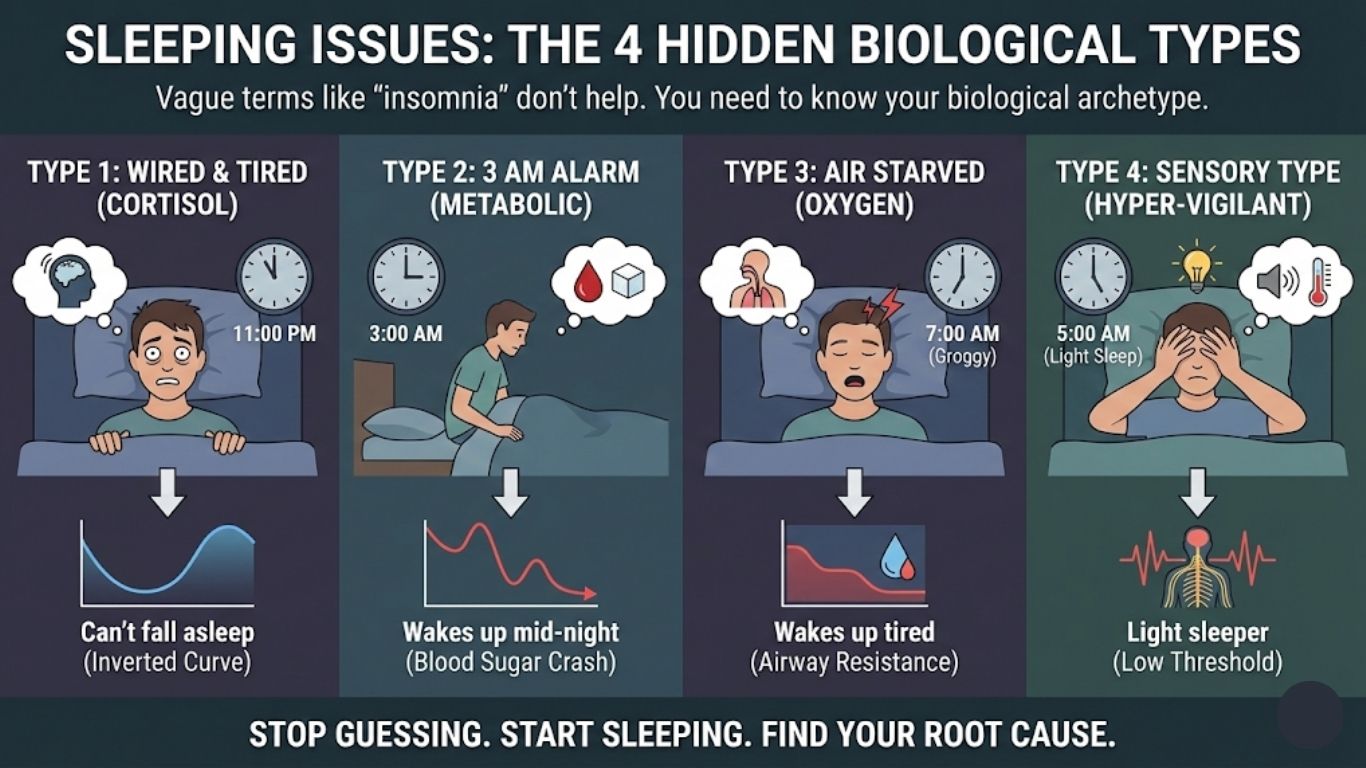
Vague terms like "insomnia" don't help. You need to know your biological archetype.
You go to bed at 10:00 PM. You wake up at 7:00 AM. But in between? It’s a mess.
Maybe you stare at the ceiling for an hour before drifting off. Maybe you wake up at 3:00 AM with your heart racing. Maybe you sleep through the night but wake up feeling like you went twelve rounds in a boxing ring.
If you are searching for "sleeping issues," you have probably realized that "drink warm milk" and "count sheep" isn't going to cut it.
That's because "sleeping issues" is a vague term for very specific biological malfunctions. Treating a cortisol problem with melatonin won't work. Treating a blood sugar crash with meditation won't work.
According to functional sleep medicine, most sleeping issues fall into 4 distinct biological archetypes.
If you want to fix your sleep, you first have to identify your type.
Type 1: The "Wired & Tired" (The Cortisol Type)
The Symptom: You are exhausted all day. You can barely keep your eyes open at dinner. But the second your head hits the pillow... Ping! Your eyes pop open. Your mind starts racing. You feel physically tense.
The Cause
This is Hyper-Arousal Insomnia. Your body has an inverted Cortisol Curve. Cortisol (the stress hormone) should be high in the morning and low at night. For you, it’s spiking at night. Your nervous system thinks you are in danger, so it refuses to let you enter deep sleep.
The Fix
- Do: Breathwork (4-7-8 breathing) and Magnesium Glycinate to lower body temp.
- Don't: High-intensity cardio after 6 PM (it spikes cortisol).
Type 2: The "3 AM Alarm" (The Metabolic Type)
The Symptom: You fall asleep fine. But every night, like clockwork, you wake up between 2:00 AM and 4:00 AM. You aren't groggy—you are wide awake, sometimes with a racing heart or sudden hunger.
The Cause
This is Nocturnal Hypoglycemia (Nighttime Blood Sugar Crash). Your brain runs on glucose. If your blood sugar drops too low while sleeping, your brain panics. It releases adrenaline to dump stored sugar into your bloodstream. That adrenaline spike is what wakes you up.
The Fix
- Do: Eat a "Safety Snack" 30 minutes before bed (a small piece of cheese, almond butter, or turkey). Protein + Fat stabilizes blood sugar.
- Don't: Drink alcohol before bed (it worsens the sugar crash).

Type 3: The "Air Starved" (The Oxygen Type)
The Symptom: You sleep for 8 or 9 hours, but you wake up with a headache, dry mouth, or heavy brain fog. You feel "hungover" without drinking.
The Cause
This is often Upper Airway Resistance or Mouth Breathing. If you breathe through your mouth at night, you stay in "light sleep" and get 20% less oxygen saturation. You are essentially suffocating in slow motion all night, preventing your brain from cleaning out toxins.
The Fix
- Do: Use Mouth Tape (specialized sleep strips) or nasal dilators to force nasal breathing.
- Don't: Sleep on your back (it causes gravity to collapse the airway).
Type 4: The "Princess & The Pea" (The Sensory Type)
The Symptom: You are a "light sleeper." If the room is 1 degree too hot, you can't sleep. If there is a tiny LED light, you can't sleep. If a car drives by, you wake up.
The Cause
You have a Low Sensory Threshold. Your nervous system is hyper-vigilant. It is failing to "gate out" environmental stimuli. While most people can ignore background noise, your brain processes it as a threat, pulling you out of REM cycles repeatedly.
The Fix
- Do: Create a "Sensory Deprivation Chamber." 100% Blackout mask, White Noise machine, and cool temperature (65°F).
- Don't: Allow pets in the bed (their micro-movements destroy your sleep quality).
Stop Guessing. Start Sleeping.
Reading these types is helpful, but you might feel like you are a mix of two or three.
Are you waking up because of cortisol? Or blood sugar?
Is your fatigue from lack of oxygen? Or lack of deep sleep?
You cannot solve the problem until you pinpoint the root cause.
We created the Free Sleep Archetype Assessment. It asks 5 specific questions about your physical symptoms (temperature, timing, hunger, tension) to diagnose exactly which biological system is sabotaging your rest—and gives you a custom protocol to fix it.