Sleep Improvement: Why 8 Hours Isn't Enough (And How to Get "Deep" Rest)
You got the hours, but you still feel like a zombie. Here is why "Junk Sleep" is ruining your recovery.
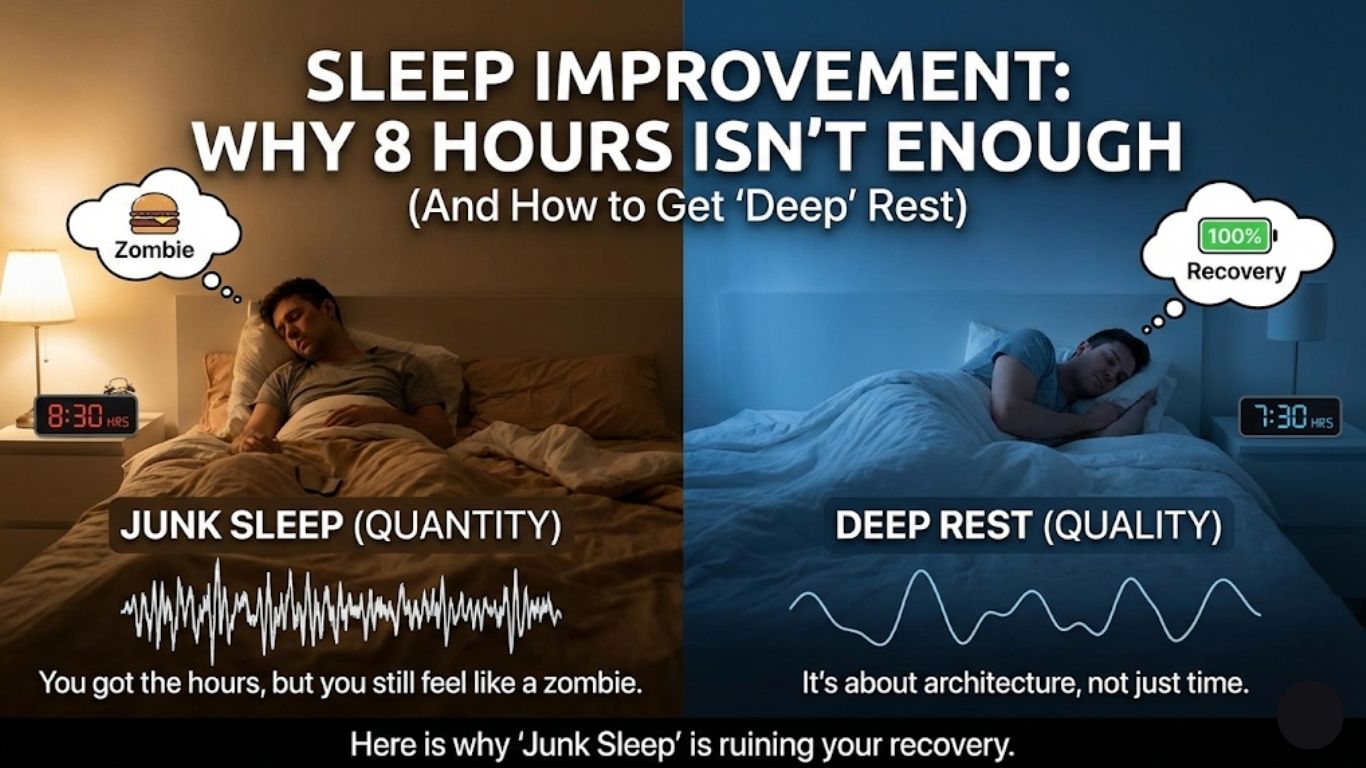
You do the math every night. "If I fall asleep right now, I’ll get 7 hours and 42 minutes."
You wake up, check your fitness tracker, and see that you hit your goal. You got the hours. So why do you still feel like you were hit by a truck?
If you are searching for "sleep improvement," you have likely fallen for the biggest lie in the wellness industry: The idea that sleep is just a number.
Sleep is not a flat line; it is a complex architecture of cycles. You can sleep for 9 hours, but if you don't hit the restorative stages (Deep Sleep and REM), you are consuming "Junk Sleep." It’s the nutritional equivalent of eating 2,000 calories of candy—you got the volume, but zero sustenance.
True sleep improvement isn't about staying in bed longer. It’s about increasing your Sleep Efficiency.
Here are 4 science-backed ways to stop getting "Junk Sleep" and start getting recovery, backed by leading neuroscientists.
1. The "Circadian Anchor" (Morning Light)
If you want to sleep better tonight, you have to start this morning.
The Expert View
According to Dr. Andrew Huberman (Stanford Neurobiologist), your sleep timer is not set when your head hits the pillow. It is set the moment sunlight hits your eyes in the morning. This triggers a "Cortisol Pulse" that starts a roughly 14-hour countdown. When that timer runs out, your body releases melatonin.
The Improvement Strategy
- The Rule: View outdoor light within 30–60 minutes of waking up.
- The Duration: 10 minutes on a sunny day, 20 minutes on a cloudy day.
- Why: If you miss this window, your "sleep timer" drifts, making you feel "tired but wired" at 11:00 PM.
2. Stop "Sedating" Yourself (The Alcohol Trap)
Many people use a glass of wine or whiskey as a "nightcap" to help them fall asleep. This is arguably the single most destructive thing you can do for sleep quality.
The Expert View
Dr. Matthew Walker, author of Why We Sleep, famously states: "Sedation is not sleep." Alcohol knocks out your cortex (sedation), but it effectively fragments your sleep. It creates a state of "fight or flight" during the night, spiking heart rate and—crucially—blocking REM Sleep (the stage responsible for emotional regulation and memory).
The Improvement Strategy
- The Rule: If you drink, stop at least 3 hours before bed.
- The Reality: Even one drink can reduce sleep quality by 20–30%. If you really want to improve your energy, try a "Dry Week" and watch your sleep score skyrocket.
3. Drop the Temperature (The Thermal Trigger)
Your body cannot enter deep, restorative sleep if your core temperature is too high.
The Expert View
Evolutionarily, we slept outdoors where the temperature dropped at night. Our biology expects this drop as a signal to release melatonin. Modern homes are insulated and heated, which confuses the brain.

The Improvement Strategy
- The Metric: Your bedroom should be around 65°F (18°C).
- The Hack: If you can't control the room temp, take a hot shower or bath 90 minutes before bed.
Why it works: It sounds counterintuitive, but the hot water brings blood to the surface of your skin. When you step out, that heat radiates off you, causing your core temperature to plummet rapidly. That sudden drop is a biological "knockout punch."
4. Fix Your "Social Jetlag" (Consistency)
Do you sleep 11:00 PM to 7:00 AM on weekdays, but 1:00 AM to 10:00 AM on weekends? You are giving yourself jetlag every single week.
The Expert View
Your body loves predictability. It prepares hormones/enzymes before you need them based on your routine. When you shift your sleep window by 3 hours on the weekend, you confuse your biological clock (Circadian Rhythm). This is called "Social Jetlag."
The Improvement Strategy
- The Hard Rule: Wake up at the same time every day +/- 30 minutes. Even on Sundays.
- The Benefit: If you stabilize your wake time, your sleep time will naturally regulate itself within a week.
"I Do All This... So Why Am I Still Tired?"
You get the morning light. You quit the wine. You keep the room cold. You wake up at 7:00 AM every day.
But you are still waking up groggy, or waking up at 3:00 AM with a racing heart.
If general "Sleep Improvement" advice isn't working, it’s because your problem isn't behavioral. It’s biological.
You might have a hidden blocker—like a Cortisol Spike, a Blood Sugar Crash, or an Oxygen Deficiency—that no amount of "routine" can fix.
You need to know your specific sleep phenotype.
We created the Free Sleep Archetype Assessment. It analyzes your specific struggle (e.g., "I can't fall asleep" vs. "I can't stay asleep") to reveal the exact biological mechanism blocking your recovery.