Sleep Deprived? How to Survive the Workday When You’ve Only Slept 4 Hours
The military-grade protocol to hack your alertness when your battery is at 10%.
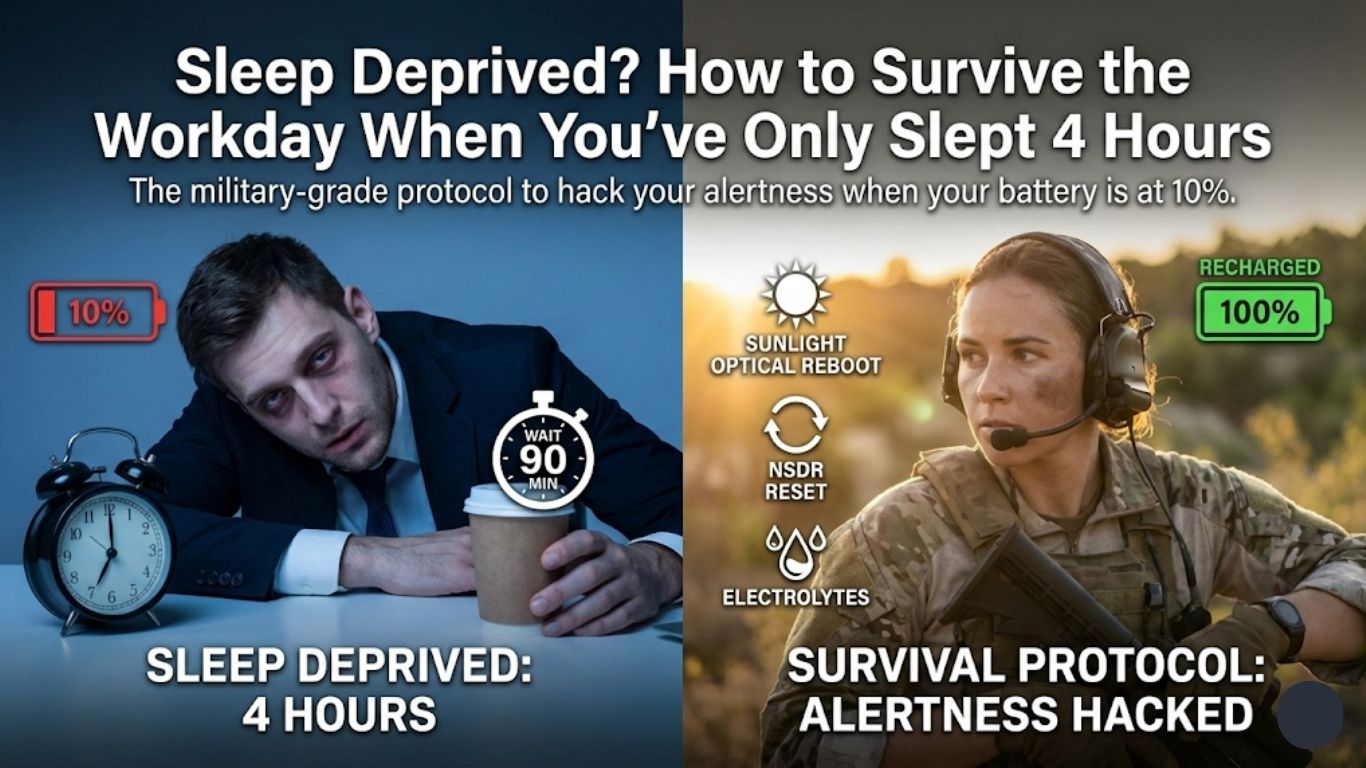
The alarm goes off. It feels like you just closed your eyes. Your eyelids are heavy, your head is throbbing, and the thought of opening your email makes you want to cry.
You are sleep deprived.
Maybe it was a deadline. Maybe it was a crying baby. Maybe it was "revenge bedtime procrastination." It doesn't matter why you are here; what matters is that you have to function for the next 8 hours without collapsing.
If you are searching for "sleep deprived," you aren't looking for a lecture on why you need 8 hours (you know that). You are looking for a survival guide.
Here is the military-grade protocol to hack your alertness, mitigate the damage, and get through the day without destroying your health.
1. Don't Drink Coffee Immediately (Wait 90 Minutes)
Your instinct is to crawl to the coffee machine the second you wake up. Don't.
The Science
When you are sleep deprived, your levels of Adenosine (the "sleep pressure" molecule) are high. But your Cortisol (stress hormone) naturally spikes when you wake up to help you get moving. If you drink coffee immediately, the caffeine competes with the cortisol spike and can actually lead to a harder crash in the afternoon.
The Survival Tactic
Wait 90 minutes after waking up before your first cup. This allows your natural cortisol to clear the initial fog. Then, use caffeine as a strategic booster, not a crutch.
2. Get Outside (The "Optical" Reboot)
You will want to stay in the dark. Fight that urge.
The Science
Your circadian clock is confused. The fastest way to tell your brain "It is time to be awake" is through the eyes. Bright light triggers the release of Dopamine and Norepinephrine—the exact neurotransmitters you are currently lacking.
The Survival Tactic
Go outside for 10 minutes immediately. Do not wear sunglasses. If you can't go outside, turn on every light in your office or use a specialized "SAD Lamp" (10,000 lux) aimed at your face.
3. The "NSDR" Reset (The 20-Minute Hack)
You might be tempted to take a nap at lunch. But if you nap for 45 minutes, you will wake up with "Sleep Inertia"—feeling even worse than before.
The Science
NSDR (Non-Sleep Deep Rest) or Yoga Nidra is a guided relaxation technique that mimics the brain waves of deep sleep without actually falling asleep. Stanford neuroscientist Dr. Andrew Huberman cites studies showing that 20 minutes of NSDR can replenish dopamine and reduce stress hormones more effectively than a nap.
The Survival Tactic
Put on headphones. Search for "20 Minute NSDR" on YouTube. Lie down (or sit back) and follow the instructions. It acts as a system reboot for your nervous system.

4. Hydrate with Electrolytes (Not Just Water)
Sleep deprivation causes dehydration. Dehydration causes brain fog.
The Science
Your brain is an electrical organ. It needs sodium and potassium to fire signals. When you are tired, your neurons are firing slowly. If you drink plain water, you might flush out minerals, making the electrical signaling even slower.
The Survival Tactic
Drink 16oz of water with a pinch of high-quality sea salt (or an electrolyte packet) before noon. This helps maintain blood pressure and cognitive speed.
5. Do Not "Eat the Frog" (Task Management)
Productivity gurus tell you to do your hardest task first. Today is not the day for that.
The Science
Sleep deprivation severely impairs your Prefrontal Cortex—the part of your brain responsible for complex decision-making, emotional regulation, and logic. However, your "primitive" brain (motor skills, simple tasks) works fine.
The Survival Tactic
Do "Zombie Work." Clear your inbox. Organize files. Fill out expense reports. Do the tasks that require zero creativity. Save the creative or strategic work for tomorrow when your prefrontal cortex is back online.
Are You "Just Tired"? Or Is This Chronic?
Everyone has a bad night occasionally. But if you feel "sleep deprived" even when you get 7 or 8 hours of sleep, that is not normal.
That is not "tiredness." That is dysfunction.
You might be suffering from:
- "Junk Sleep" (Poor quality/no REM).
- Adrenal Burnout (High cortisol).
- Oxygen Deprivation (Sleep apnea/Mouth breathing).
You cannot fix a biological problem with more coffee. You need to find the root cause.
We created the Free Sleep Archetype Assessment. It analyzes your specific symptoms (e.g., morning headaches, 3 AM wake-ups, brain fog) to tell you exactly why your sleep isn't recharging you—and how to fix it permanently.