The "Junk Sleep" Epidemic: Why You Wake Up Tired (And How to Fix Your Sleep Quality)
You sleep 8 hours but feel terrible. Sleep is not just a number.
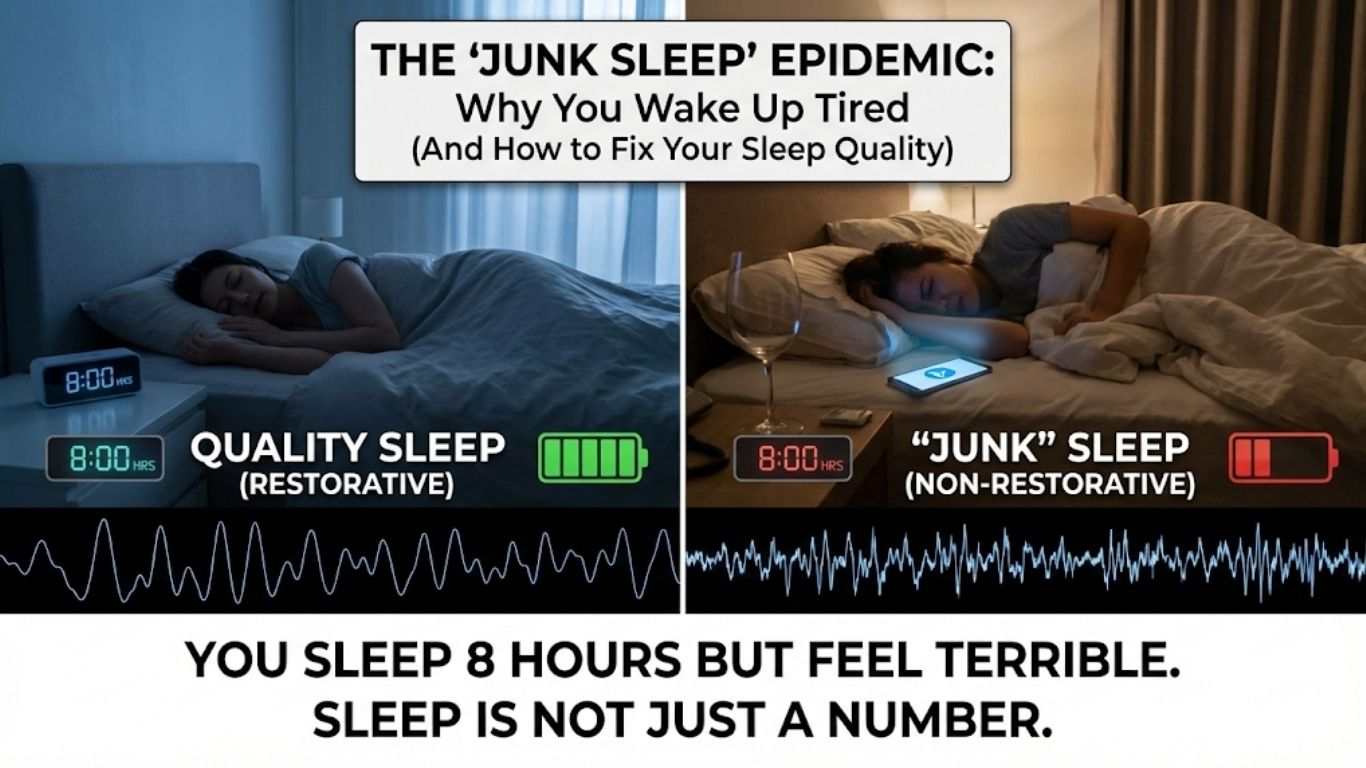
You look at your fitness tracker. It says you slept for 7 hours and 52 minutes. You do the math. That’s nearly 8 hours. You should feel amazing.
But you don’t. You drag yourself out of bed. You need three coffees to start your brain. You feel heavy, foggy, and irritable.
If you are searching for "sleep quality," you have discovered the uncomfortable truth: Sleep is not just a number.
You can sleep for 9 hours and still be exhausted if you are getting "Junk Sleep." Just like eating 2,000 calories of sugar is different from eating 2,000 calories of steak and vegetables, not all sleep minutes are created equal.
If you aren't hitting the restorative stages—Deep Sleep (for physical repair) and REM Sleep (for emotional repair)—you are technically unconscious, but you aren't recovering.
Here are the 4 biggest destroyers of sleep quality, backed by neuroscience, and how to fix them to stop wasting your nights.
1. The "Nightcap" Lie (Alcohol & REM)
Many people use a glass of wine to help them fall asleep. It works to knock you out. But it destroys your quality.
The Science
According to Dr. Matthew Walker, author of Why We Sleep, alcohol is a sedative, not a sleep aid. It might help you lose consciousness faster, but it is one of the most powerful suppressors of REM Sleep (Rapid Eye Movement). This is the stage where your brain processes emotions and consolidates memories. When you drink, you might sleep for 8 hours, but you wake up with "fragmented" sleep architecture, leaving you feeling anxious and unrefreshed.
The Fix
- The Rule: Implement a "3-Hour Curfew." Stop drinking at least 3 hours before bed to allow your liver to metabolize the alcohol before you sleep.
2. The Thermal Block (Temperature & Deep Sleep)
Do you wake up sweaty? Or kicking the covers off? That is a quality killer.
The Science
Your body naturally drops its core temperature to enter Deep Sleep (Delta Waves). This is when your body releases Growth Hormone and repairs muscle tissue. If your room is too warm (above 70°F/21°C), your body struggles to dump heat. Your heart rate stays elevated, and your nervous system stays in "light sleep" mode to regulate your temperature.

The Fix
- The Optimal Range: Sleep scientists recommend a room temperature between 60–67°F (15–19°C).
- The Hack: If you can't cool the room, take a hot shower before bed. The rapid cooling when you step out of the shower tricks your body into dropping its core temperature.
3. The "Blue" Melatonin Crash (Light)
You turn off the lights, but you scroll on your phone for 20 minutes in the dark.
The Science
Your brain interprets Blue Light (from LEDs and screens) as "Noon Sunlight." Even a small amount of light hitting the retina suppresses the release of Melatonin—the hormone that signals sleep timing. This doesn't just make it harder to fall asleep; it shifts your circadian phase, reducing the depth of sleep you get in the first 4 hours of the night.
The Fix
- The Protocol: No screens 60 minutes before bed.
- The Tool: If you must use screens, wear Blue Light Blocking glasses (the ones with red/orange lenses) after sunset.
4. The "Sleep Apnea" Ghost (Oxygen)
You might think you are sleeping soundly. But you might be suffocating.
The Science
Mild Sleep Apnea or Upper Airway Resistance can cause "micro-arousals." Your airway collapses slightly, your brain senses a lack of oxygen, and it jolts you into a lighter stage of sleep to breathe. This can happen 20–30 times an hour without you ever fully waking up. You think you slept for 8 hours, but you never actually entered deep restoration.
The Fix
- The Test: If you snore, wake up with a dry mouth, or have morning headaches, this is a major red flag.
- The Hack: Try sleeping on your side or using "Mouth Tape" to encourage nasal breathing, which keeps the airway open.
Quantity is Easy. Quality is Hard.
You can buy blackout curtains. You can quit the wine. You can tape your mouth.
But what if you do all of this, and your sleep quality is still low?
Then the problem isn't your routine. It’s your metabolic biology.
- Are you waking up because of a Cortisol Spike?
- Are you missing Deep Sleep because of a Blood Sugar Crash?
- Is your nervous system stuck in "Fight or Flight"?
You need to know your specific sleep phenotype to fix the quality.
We created the Free Sleep Archetype Assessment. It measures your specific symptoms (e.g., dreaming patterns, wake-up times, energy levels) to calculate your Sleep Quality Score and tell you exactly which biological system is sabotaging your recovery.