It Starts at 7 AM: The 4 "Daytime" Sleep Habits That Determine Your Night
You think insomnia happens at night. But your sleep is determined by what you did 12 hours ago.
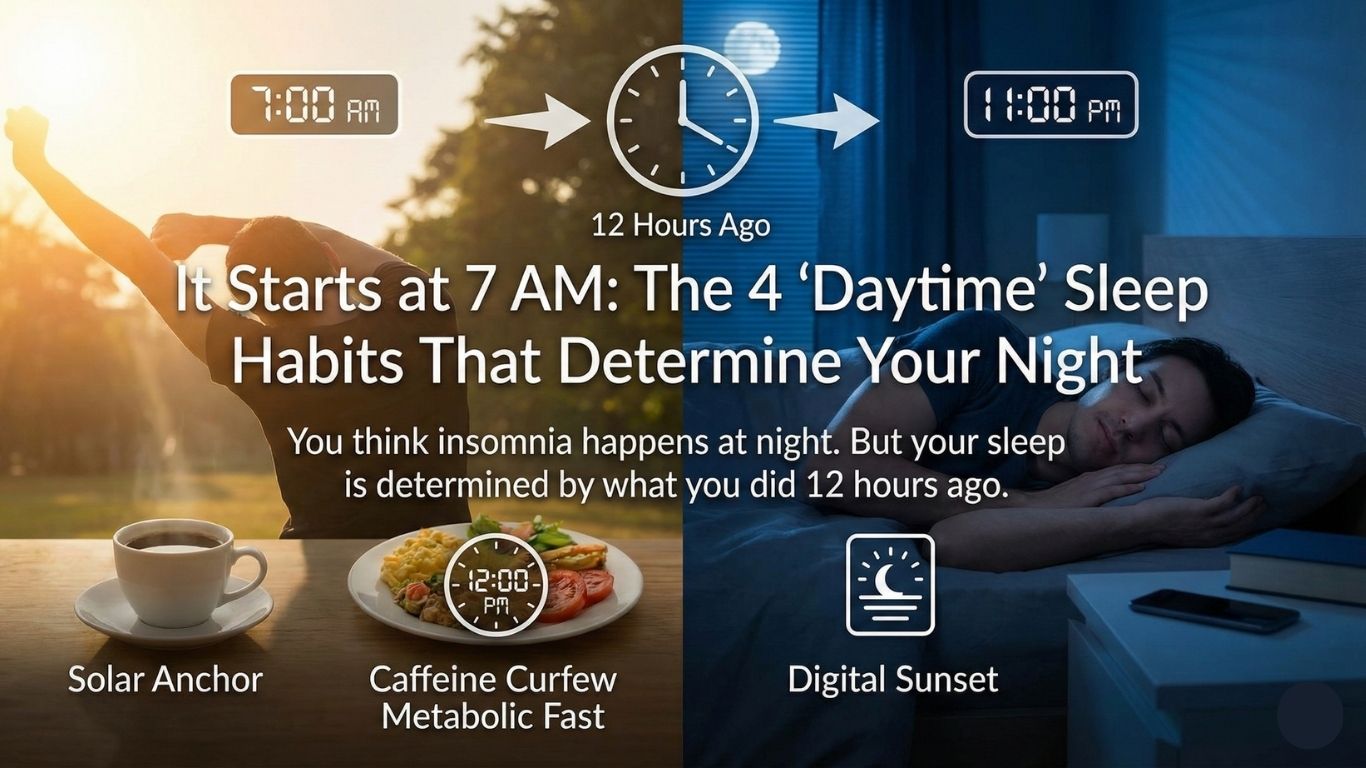
You think insomnia happens at night. You lie in bed at 11:00 PM, frustrated, trying to force your brain to shut down.
But asking your brain to sleep when it isn't ready is like trying to stop a freight train in 10 feet. It’s impossible.
If you are searching for "sleep habits," you need to understand the Golden Rule of Rest: Your sleep is determined by what you did 12 hours ago.
Sleep is not a switch you flip; it is a biochemical timer that starts the moment you wake up. If you don't wind the clock in the morning, the alarm won't ring at night.
Here are the 4 non-negotiable sleep habits that happen before you ever put on your pajamas.
1. The "Solar Anchor" (The Morning Habit)
The most important sleep habit takes place within 30 minutes of waking up.
The Science
Your brain has a "Master Clock" called the Suprachiasmatic Nucleus. It needs to know when "Day" begins so it can calculate when "Night" should happen roughly 16 hours later. The only way to set this clock is with bright light (photons) hitting the retina. If you stay in a dark room until 10:00 AM, your brain thinks the day started late. Consequently, it won't release Melatonin (the sleep hormone) until 2:00 AM the next morning.
The Habit
Get outside for 10 minutes immediately after waking up. No sunglasses. This "anchors" your circadian rhythm and guarantees you will feel sleepy at the right time tonight.
2. The "Caffeine Curfew" (The Afternoon Habit)
You can fall asleep with caffeine in your system. But you cannot get Deep Sleep.
The Science
Caffeine has a "half-life" of about 5 to 7 hours. If you drink a Starbucks Grande (300mg of caffeine) at 4:00 PM, you still have ~150mg of caffeine in your blood at 10:00 PM. That is the equivalent of drinking half a cup of coffee right before bed. It might not stop you from passing out, but it chemically blocks Deep Slow-Wave Sleep, leaving you waking up feeling unrefreshed.
The Habit
Implement a strict 10-Hour Rule. If you want to sleep at 10:00 PM, your last sip of caffeine must be before 12:00 PM (Noon).
3. The "Metabolic Fast" (The Evening Habit)
Eating a heavy meal right before bed is a recipe for disaster.
The Science
Digestion is a high-energy process. It raises your core body temperature and increases heart rate. However, to sleep, your body needs to lower its temperature and slow its heart rate. If you eat a steak dinner at 9:00 PM, your biology is fighting itself. You are trying to power down while your metabolism is powering up.
The Habit
Close the kitchen 3 hours before bed. This gives your stomach time to empty, preventing acid reflux and allowing your body to focus on repair rather than digestion.

4. The "Digital Sunset" (The Pre-Bed Habit)
We are addicted to "Dopamine Looping"—scrolling, clicking, and refreshing.
The Science
It’s not just the blue light from your phone that hurts sleep; it’s the engagement. Every tweet, video, or email triggers a micro-hit of dopamine and norepinephrine (alertness). You are essentially micro-dosing stimulants while lying in the dark. You cannot go from "High Alert" to "Deep Sleep" instantly.
The Habit
Enforce a "No Tech" Zone 60 minutes before bed. Read a physical book. Listen to a podcast. Talk to your partner. Do anything that is passive rather than active.
You Have Good Habits... So Why Can't You Sleep?
You get the sunlight. You stop the coffee. You fast for 3 hours. But you are still staring at the ceiling, or waking up at 3:00 AM with a racing heart.
If you have perfect habits but terrible sleep, your problem is biological, not behavioral.
You may have an underlying mechanism—like Sleep Apnea, Cortisol Dysregulation, or Reactive Hypoglycemia—that is overriding your good habits.
You need to check under the hood.
We created the Free Sleep Archetype Assessment. It analyzes your specific symptoms (e.g., dreaming, temperature, wake-up times) to reveal exactly which biological system is blocking your rest—and whether you need a habit change or a clinical protocol.