Beyond "No Coffee": 5 Advanced Sleep Hygiene Tips for Optimal Sleep
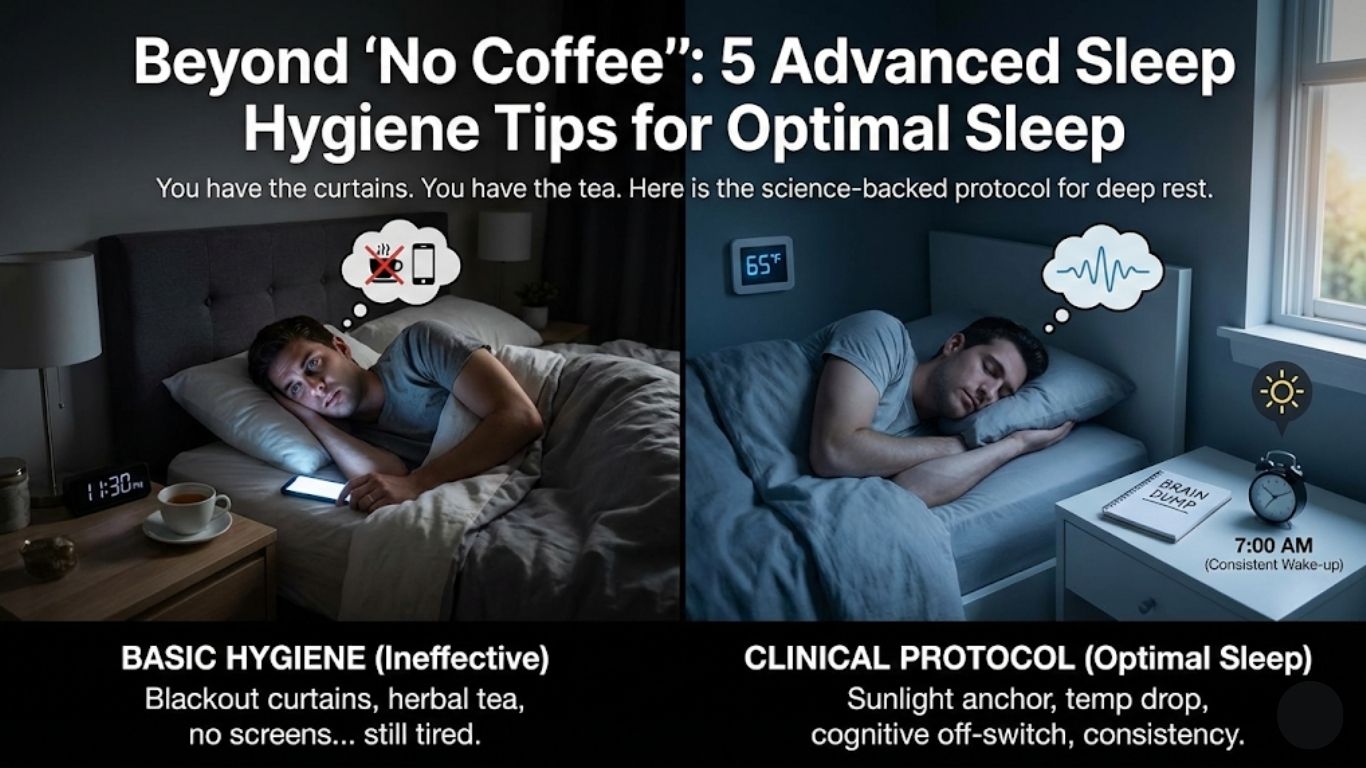
You have the blackout curtains. You drink the tea. But you are still tired. Here is the clinical protocol.
You’ve heard the basics a thousand times. "Don't drink caffeine late." "Don't look at your phone in bed." "Buy a comfortable mattress."
You follow the rules. You have the blackout curtains. You drink the herbal tea. But you are still waking up tired.
If you are searching for "sleep hygiene tips for optimal sleep," you are ready to graduate from the basics. You don't need "tips"—you need a protocol.
True sleep hygiene isn't just about what you do right before bed; it is about how you engineer your entire day to align with your biology.
Here are 5 advanced, clinical-grade sleep hygiene strategies that neuroscientists use to guarantee deep, restorative rest.
1. The "Sunlight Anchor" (Start at 8:00 AM)
Most people think sleep hygiene starts at 9:00 PM. It starts the moment you wake up.
The Science
Your circadian rhythm is governed by a "Master Clock" (the Suprachiasmatic Nucleus). This clock needs a reset signal every morning. That signal is Photons (Light). If you don't get bright light in your eyes within 60 minutes of waking up, your "sleep timer" doesn't start. This pushes your melatonin release too late, causing you to feel "wired" at midnight.
The Protocol
- The Action: Get 10–20 minutes of outdoor sunlight immediately after waking up.
- The Rule: No sunglasses. Windows block the specific light spectrum you need, so you must be outside.
2. The "Walk-Out" Rule (Stimulus Control)
Do you lie in bed for hours, staring at the ceiling, hoping to fall asleep? Stop doing that immediately.
The Science
Your brain is an association machine. If you spend 2 hours awake in bed feeling frustrated, your brain learns: Bed = Frustration/Thinking. This is called "Conditioned Insomnia." You are accidentally training yourself to be alert the moment your head hits the pillow.
The Protocol
- The Action: If you haven't fallen asleep in 20 minutes, get out of bed.
- The Rule: Go to a different room. Read a dull book in dim light. Do not return to bed until you feel physically sleepy (heavy eyelids). You must re-train your brain that Bed = Sleep Only.
3. The "Core Drop" (Temperature Manipulation)
You might like your bedroom cozy. Your biology hates it.
The Science
To initiate sleep, your core body temperature must drop by roughly 2°F. If your room is warm, your heart has to beat faster to pump blood to your skin to cool you down. This keeps your nervous system active and prevents Deep Sleep.

The Protocol
- The Action: Set your thermostat to 65°F (18°C).
- The Hack: If you hate the cold, take a hot shower 1 hour before bed. The rapid cooling when you step out of the shower mimics the body’s natural sleep signal, knocking you out faster.
4. The "Brain Dump" (Cognitive Hygiene)
Hygiene isn't just about your environment; it's about your thoughts.
The Science
The number one reason for "sleep onset latency" (taking too long to fall asleep) is Rumination. Your brain tries to "solve" tomorrow's problems because it didn't get a chance to process them during the busy day.
The Protocol
- The Action: Keep a notebook by your bed. 2 hours before sleep, write down every unfinished task and worry for tomorrow.
- The Psychology: Once it is on paper, your brain views the task as "captured" and allows the anxiety loop to close.
5. The "Sunday Consistency" (Kill Social Jetlag)
You sleep 11 PM–7 AM on weekdays, but 1 AM–10 AM on weekends. You are giving yourself jetlag every single week.
The Science
Shifting your wake-up time by just 2 hours disrupts your hormonal release patterns for the next 3 days. This "Social Jetlag" is a primary cause of "Monday Morning Brain Fog."
The Protocol
- The Action: Wake up at the same time every day, within a 30-minute window. Even on Sundays.
- The Payoff: If you stabilize your wake time, your body will naturally start making you tired at the right time every night.
Is It "Hygiene"? Or Is It Biology?
You can have the perfect temperature, the perfect blackout curtains, and the perfect routine.
But if you are still struggling to sleep, your problem isn't hygiene. It’s internal.
- If you wake up at 3 AM no matter what -> That’s a Blood Sugar issue.
- If you wake up with a headache -> That’s an Oxygen issue.
- If you can't shut off your mind -> That’s a Cortisol issue.
No amount of "tips" will fix a biological malfunction. You need to identify your specific blocker.
We created the Free Sleep Archetype Assessment. It analyzes your specific symptoms (wake-up times, physical sensations, energy levels) to tell you exactly which biological system is breaking your sleep—and the specific protocol to fix it.